
Yogananda and Maria Montessori: Development of potential and educational similarities
Going deep…What is the real meaning of education?
In the pursuit of research in education that I have long been passionate about, I have been able to discover two wonderful educational approaches: Education for Life and the Montessori Method.
Right away I was surprised by the many aspects they had in common, perhaps because of the kind of inspiration that guided their creators Yogananda and Maria Montessori.
Yogananda and Maria Montessori: Common Ground and Vision
They both had the insight to seek a way, through the education of children, to foster the full development of human potential. I don’t think they knew each other but they lived at the same time, both leaving this life in 1952.
West and East: Mutual Enrichment
In their paths they moved between the Western and Eastern worlds. Yogananda was born in India and felt called to bring the values of yoga to the West, specifically to the United States; Maria Montessori, on the other hand, was born in Italy and lived several years in India, where she was able to learn about the culture there. Both then discovered a thought and culture different from their own, choosing to focus on what they had in common and of mutual enrichment; a search for the essence of what are the best parts of human beings, beyond their specific culture of belonging.
The Global Dissemination of Schools
The spread of Montessori schools took place even while Maria Montessori was alive. The first Children’s Home was founded by her in Rome in 1907, while the first Educare alla Vita school came into being several decades later. In fact, Yogananda founded an early model school, a precursor to Educare for Life, in Ranchi, India, in 1918. He later moved to the United States, devoting himself to spreading yoga to adults and sowing the idea of world brotherhood colonies. This idea was later picked up and concretized by Swami Kriyananda, a direct disciple of his, who founded the first community in California in 1968. Here in 1972 the first real Educare alla Vita school was born, and others were later established.
The Common Principles: Child at the Center and Universal Values
Both Education for Life and the Montessori Method place the child at the center of the child’s journey of growth and learning. They share the idea that there are universal human values and that the learning and internalization of these values can begin in childhood through children’s direct experience. Experiences of cooperation, friendship, joy, and peace made by children in school settings can reinforce corresponding human qualities in today’s children and thus in tomorrow’s adults, contributing to the creation of a better humanity and world. These two approaches offer a global and universal view of life, valuing the interconnections between different disciplines and between disciplines and real life. The child then grows in the awareness that he or she is part of the world and the universe, in a state of interconnectedness with all other humans, living beings and the environment, as well as perceiving the connection between what he or she learns and real life.
Developmental Stages Compared
Educating for Life and the Montessori Method also identify specific needs common to each period of developmental age called “developmental stages” and “developmental plans.” Maria Montessori was a physician and based the Method on her scientific knowledge, characterizing it as a practical and experimental approach based on observation.
The Four Tools of Maturity in Educating for Life
Educare alla Vita aims at the balanced development of the human being and its parts: body, feeling, will and intellect, called the “tools of maturity,” providing for the formulation of all activities aimed at the child so as to involve all these aspects and considering each child’s specific inclination for one or some of these. The relationship with the child in Educating for Life takes place first through observation, then entering the child’s world through feeling, creating an intimate and deep connection.
The Transformative Role of the Teacher
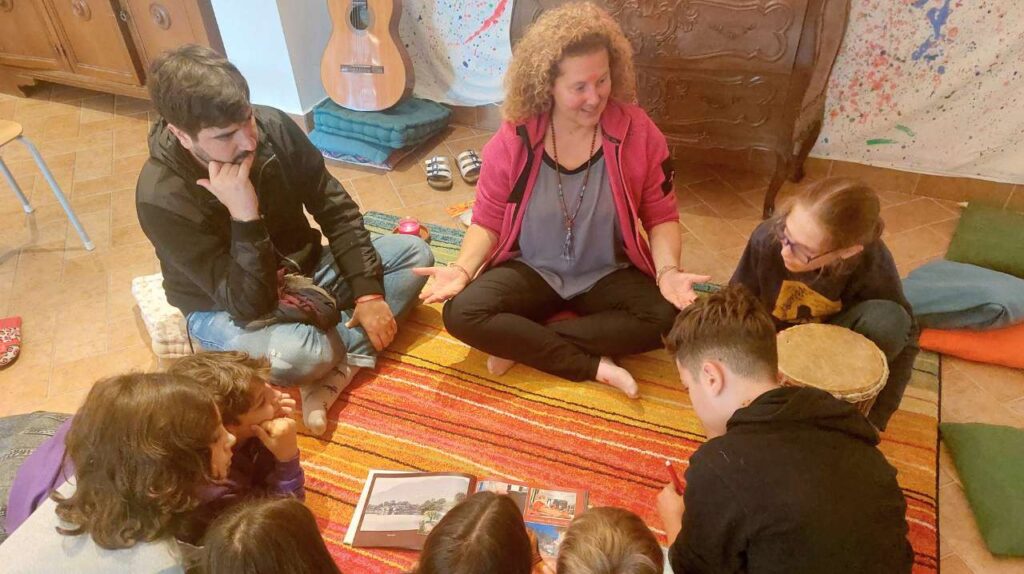
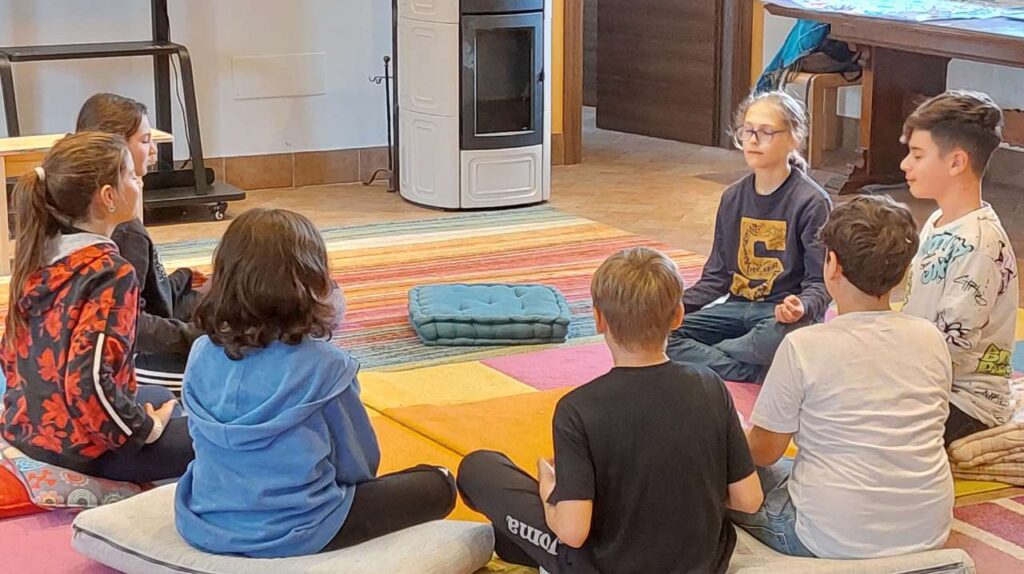
What impressed me most about Educating for Life as an educational approach is its proposal for human and spiritual growth. The teacher’s work starts with himself primarily through daily practices such as meditation and yoga, which help him to be calm, centered and aware when he enters into relationship with children. Thus the teacher not only prepares the outer environment for teaching activities, but also prepares himself, his inner environment and offers it to the child as a concrete example of those human qualities that he too can develop.
Energy Awareness and Management
Another important aspect is the teacher’s awareness of his or her own energy level. Being tired, drained, with low energy makes it very difficult to manage a classroom, while having high energy helps one to be cheerful, creative, engaging and open to the flow of events in working with children. Educating for Life proposes a path for the teacher to learn to recognize his or her own energy level and transform it if needed. This personal awareness and ability, once developed, makes the teacher capable of also recognizing the energy level of the child in front of him or her and of the whole class, adopting appropriate strategies in the individual and group relationship to make learning natural and effective, without forcing, and improve the well-being of school life.
The Approach for a Better Future and Human Maturity.
Educating for Life thus offers tools that improve inner and outer life, useful not only for teachers, but for all adults who want to get deeply involved, seeking a path of growth and expansion, and who are open to changing their perspective on their daily lives in family, work, friendships, bringing out the best in themselves. The full realization of human potential and a better humanity at this moment in history and in the future can be manifested through a path like this, made up of working on one’s energy, awareness of one’s inner self, and development of maturity.
Today we have a great need for maturity in human beings that is, as Educating for Life says, the ability to relate appropriately to realities other than one’s own, to bring cooperation, peace, joy and love into our daily realities of relationships and thus throughout the world, just as Yogananda and Maria Montessori dreamed of.